

Selection and placement of air filters
2026-05-10
Ⅰ.Selection and placement of air filters
1. In the case of small purification plants, such as clean tables, air showers, laminar flow hoods, etc., due to the small volume of air being processed, low or medium efficiency filters are usually used at the fresh air inlet, and high or ultra-high efficiency filters must be installed at the supply air outlet;
2. The selection and configuration of air filters in air purification and conditioning systems should generally be based on the level of air cleanliness in the clean room and the specific requirements of the production process.
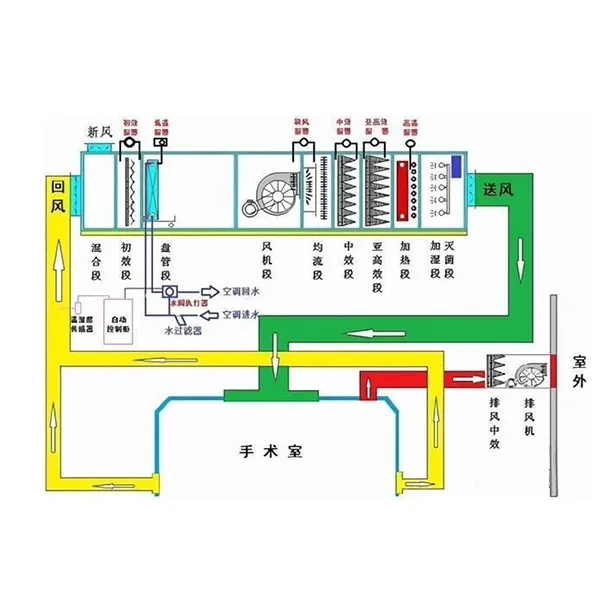
Class 1000–100,000 cleanroom systems typically use a three-stage air filtration system, that is, coarse, medium, and high efficiency filters; Coarse and medium efficiency filters are typically installed in air handling units, with medium efficiency filters located in the positive pressure zone and semi-high efficiency or high efficiency filters typically located at the outlet of the air conditioning system.
For air conditioning systems with cleanliness class 100–1000, it is common to install coarse, medium-efficiency, and semi-high-efficiency filters in the fresh air handling units, and additionally install high-efficiency or ultra-high-efficiency filters in the cleanroom air circulation system; Typically, high-efficiency filters are located at the end of the air-handling air conditioning system, that is, in the ceiling of the clean room; As for ultra-high efficiency filters, they should be installed at the end of the air conditioning system with air purification to ensure the required level of air purity.
3.If the air flow rate of the cleaning system is known, the required number of filters can be determined based on the rated flow rate of the selected filters.
Ⅱ.Application areas and filtration range of air filters:
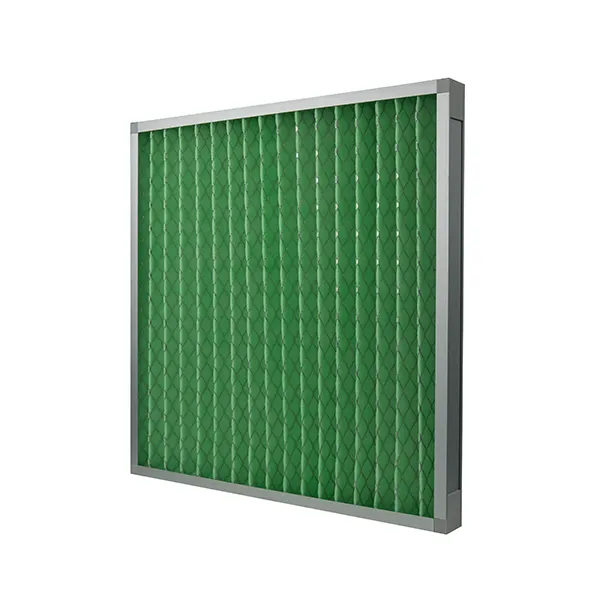
1. Coarse filters are mainly used as pre-filters at the fresh air inlet of air conditioning systems to retain large particles from the atmosphere. They are designed to capture suspended particles larger than 5 microns, settling particles larger than 10 microns, as well as various foreign objects, preventing them from entering the system. Rubberized wool, polyester non-woven material and polypropylene fibers are usually used as filter materials. Filtration efficiency is determined by trapping particles ≥5 µm in size.
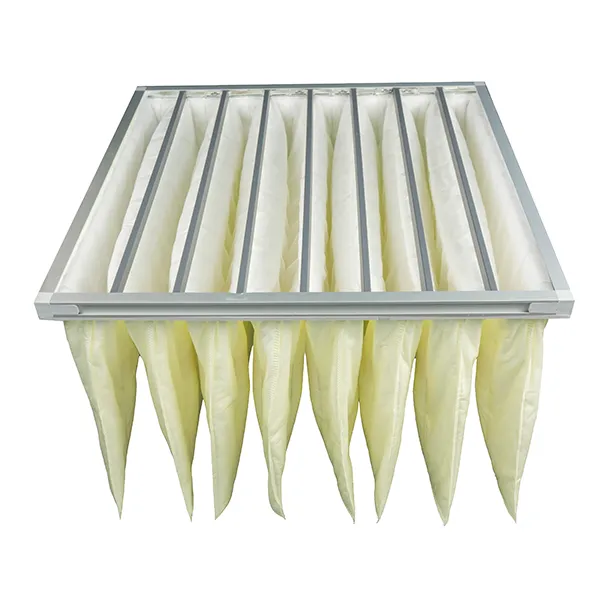
2.Medium efficiency air filters, since large particles are already retained by the preceding pre-filter, can be used as final filters in conventional air conditioning systems, as well as pre-filters for medium and high efficiency filters in air purification systems. Polyester non-woven fabric, polypropylene fibers and glass fiber are commonly used as filter media.
Primarily used to capture suspended particles 1-10 µm in size, efficiency is determined by filtering particles ≥1 µm in size.
3. Medium and high efficiency filters can be used as final filters in systems with a general purification level, as well as intermediate filters before high-efficiency filters; Polyester non-woven fabric, polypropylene fibers and glass fiber are commonly used as filter media. Primarily used to capture particles 1–5 µm in size, efficiency is determined by filtering particles ≥1 µm in size.
4.Semi-high efficiency filters are mainly used as final filters in clean rooms, and also as pre-filters for high efficiency filters and final filters in supply air systems to improve the quality of supply air. Polypropylene fibers and glass fiber are commonly used as filter media. Primarily used to capture particles smaller than 1 µm, efficiency is determined by filtering particles ≥0.5 µm in size.
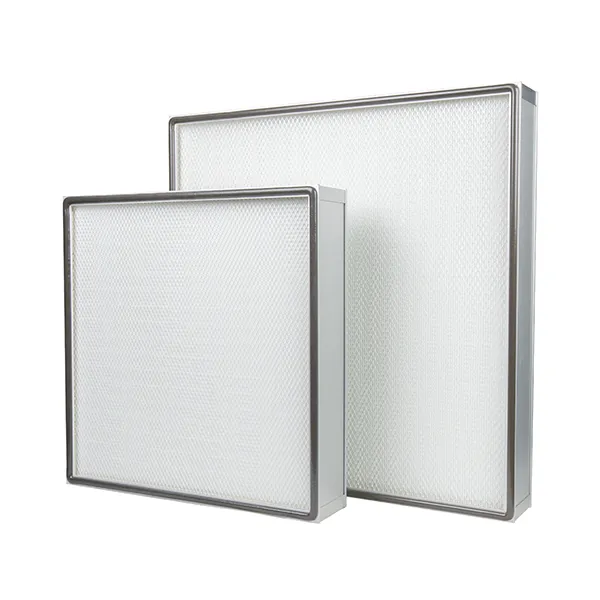
5.High efficiency filters (ultra high efficiency filters) are mainly used as final filters in cleanrooms to ensure the required level of cleanliness.
Their effectiveness is determined by filtering particles ≥0.5 microns in size. Ultra-thin glass fiber is usually used as a filter material.
Ⅲ.Various ways to indicate the efficiency of air filters: If the concentration of dust in the filtered gas is expressed as mass concentration, then the efficiency is called mass efficiency; if it is expressed as a quantitative concentration, then the effectiveness is called quantitative efficiency; if it is expressed as a relative value for other physical quantities, then it is colorimetric efficiency or turbidity efficiency, etc.
The most common designation is quantified efficiency, expressed as the concentration of dust particles in the air flow at the filter inlet and outlet.
1.At rated air flow, in accordance with the provisions of national standards GB/T14295-93 "Air Filters" and GB13554-92 "High Efficiency Air Filters", the efficiency range of different filters is as follows:
Coarse filters: for particles ≥5 µm in size, filtration efficiency 80 > E ≥ 20, initial resistance ≤ 50 Pa
Medium efficiency filters: for particles ≥1 µm, filtration efficiency 70 > E ≥ 20, initial resistance ≤ 80 Pa
High efficiency filters: for particles ≥1 µm, filtration efficiency 99 > E ≥ 70, initial resistance ≤ 100 Pa
Semi-high efficiency filters: for particles ≥0.5 µm, filtration efficiency E ≥ 95, initial resistance ≤ 120 Pa
High efficiency filters: for particles ≥0.5 µm, filtration efficiency E ≥ 99.99, initial resistance ≤ 220 Pa
Ultra-high efficiency filters: for particles ≥0.1 µm, filtration efficiency E ≥ 99.999, initial resistance ≤ 280 Pa
2. Since many enterprises currently use imported filters, and their efficiency designation system differs from the domestic one, for ease of comparison we present a table of the relationships between them:
According to European standards, coarse filters are divided into four classes (G1–G4):
G1: particle efficiency ≥5.0μm, filtration efficiency E ≥20% (meets American standard C1)
G2: Efficiency for particles ≥5.0 µm, filtration efficiency 50 > E ≥ 20% (meets American standard C2–C4)
G3: Efficiency for particles ≥5.0 µm, filtration efficiency 70 > E ≥ 50% (meets American standard L5)
G4: Efficiency for particles ≥5.0μm, filtration efficiency 90 > E ≥ 70% (meets American standard L6)
Average efficiency filters are divided into two classes (F5~~F6):
F5 Efficiency: for particles ≥1.0μm in size, filtration efficiency 50 > E ≥ 30% (meets American standard M9, M10)
F6 efficiency for particles ≥1.0μm: filtration efficiency 80 > E ≥ 50% (meets American standard M11, M12)
Medium and high efficiency filters are divided into three levels (F7~~F9):
F7 efficiency for particles ≥1.0 µm: filtration efficiency 99 > E ≥ 70% (meets US standard H13)
F8 Efficiency: for particles ≥0.5μm in size, filtration efficiency 90% > E ≥ 75% (meets American standard H14)
F9 Efficiency: for particles ≥0.5μm in size, filtration efficiency 99% > E ≥ 90% (meets American standard H15)
Semi-high efficiency filters are divided into two classes (H10, H11):
H10: Efficiency for particles ≥0.5μm, filtration efficiency 99% > E ≥ 95% (meets American standard H15)
H11: Efficiency for particles ≥0.5μm, filtration efficiency 99.9% > E ≥ 99% (meets American standard H16)
High efficiency filters are divided into two classes (H12, H13):
H12: Particle filtration efficiency ≥0.5μm, E filtration efficiency ≥99.9% (meets American standard H16)
H13: Particle filtration efficiency ≥0.5μm, E filtration efficiency ≥99.99% (meets American standard H17)