

Operating principle of the cleanroom air conditioning system
2026-05-05
Ⅰ. Operating principle of the clean room air conditioning system
1. Concept of air conditioning system for clean rooms:
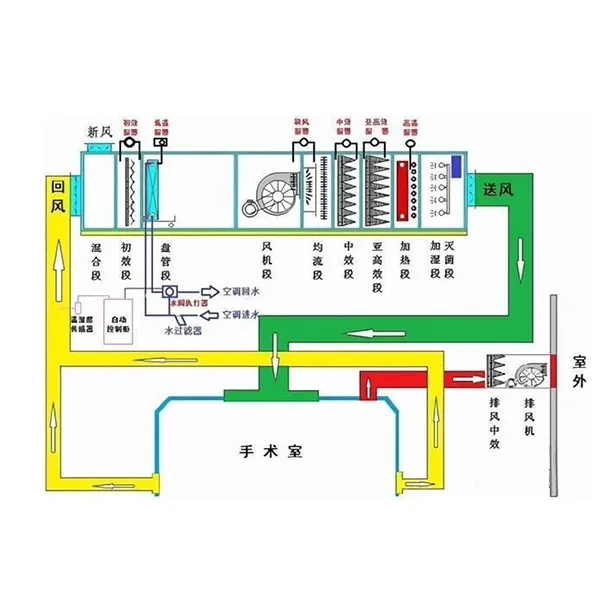
To maintain the required parameters in a cleanroom, such as temperature, humidity, air flow rate, pressure and degree of cleanliness, a method is usually used to continuously supply a certain amount of treated air into the room, which eliminates various thermal and humidity disturbances, as well as dust contamination, both inside and outside the cleanroom. To obtain air entering a clean room in a certain state, a whole complex of equipment is required for air treatment, continuous supply of it into the room and constant removal of part of the air from the room; This set of equipment constitutes the cleanroom air conditioning system.
2. Composition of the cleanroom air conditioning system:
(1) Equipment for heating or cooling, humidification or dehumidification, and cleaning;
(2) Equipment for supplying and circulating treated air into cleanrooms and associated piping;
(3) Systems providing the system with heat, cooling, heating and cooling sources, and associated piping systems.
3. Classification of air conditioning systems for clean rooms:
(1) Centralized cleanroom air conditioning systems: All necessary equipment for cleaning and air conditioning in one or more cleanrooms of the system is concentrated in a technical room, and clean air is supplied to each cleanroom through ducts.
(2) Decentralized cleanroom air conditioning systems: Each cleanroom in the system is separately equipped with purifying or air conditioning equipment.
(3) Semi-centralized cleanroom air conditioning systems: These systems have both a centralized room for cleaning equipment and air handling equipment distributed throughout individual cleanrooms. This is a form that combines centralized and local processing.
4. Operating principle of cleanroom air conditioning systems:
Can be summarized as “three prevention measures and one removal.” Preventing the direct entry of fine dust into the room, preventing the accumulation of particles, preventing the formation of particles as much as possible, and effectively and quickly removing particles formed in the room.
5.Use of air conditioning systems for clean rooms:
Cleanroom air conditioning systems are a new technology designed to meet the requirements of experimental research and product manufacturing in the areas of precision, miniaturization, high purity, high quality and high reliability. They are widely used in aerospace, precision machining, fine chemicals, hospital surgery, electronics, pharmaceuticals, food processing and other fields.
Ⅱ.Common problems in purified air conditioning systems and how to fix them
Problem 1:
Measures to eliminate leaks in combined air conditioning systems: preventing the defrosting phenomenon. Details: During winter in northern regions, most companies using combined air conditioners experience significant leakage from the system, which seriously affects the normal production process. Last year, a large leak suddenly occurred in the precision packaging drying workshop. Technicians conducted a thorough search for the cause, ruling out leaks from the heater and humidifier, and discovered a leak in the cooler. What was the reason? After shutting down the refrigeration unit and draining the water from the system, we worked with engineering, manufacturing, and management to perform several on-site analyzes and ultimately discovered that the water leak was caused by the chiller defrosting. Despite draining water from the system, “blind zones” remained at the lowest point, from which water could not be drained, which led to the entry of a large amount of cold air in winter and defrosting of the cooler pipes. During the investigation, it turned out that most manufacturers of combined air conditioners have such “blind spots” from which it is impossible to completely drain the water.
Ways to solve this problem: when ordering equipment, ask the manufacturer to add a drain at the lowest point; treat the supply air by adding a preheating section to ensure that after treatment the supply air temperature in winter reaches 5 °C or higher; use an electric heater, as steam heaters also have the problem of defrosting.
Question 2:
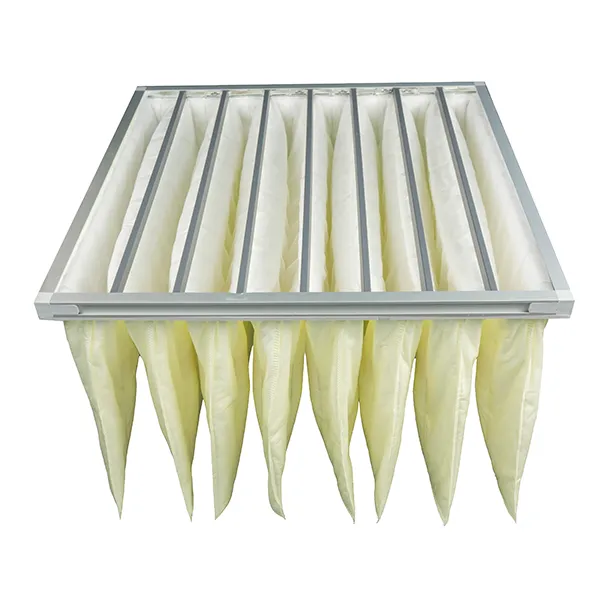
Measures to solve the problem of short service life of medium-efficiency filters: increase the length of the uniform air distribution section. Details: Some combination air conditioners have a relatively short lifespan of average efficiency filters and their filtration performance is not ideal. Frequent replacement of medium-efficiency filters not only results in high operating costs, but also reduces the service life of high-efficiency filters. As a result of careful research and comparison, it was discovered that in some companies, due to the small area of air-conditioning rooms, designers, striving for a compact design, connect the medium-efficiency filter section directly to the fan section, as a result of which the processed air does not have time to be distributed, which leads to an extremely uneven air filtration rate throughout the entire cross-section of the medium-efficiency filter at the outlet of the fan. This not only affects the air handling efficiency of the entire air conditioning unit, but also significantly reduces the service life of the filter. The solution to this problem is to add a flow equalization section between the fan section and the medium efficiency filtration section.
Question 3:
The pressure drop and air flow do not meet the requirements. Action: Conduct active checks and make local adjustments carefully. Details: One day, at one of the drug production workshops, it was discovered that the pressure drops in various rooms were unstable. As a result, the workshop operators went up to the technical mezzanine and adjusted some of the supply and exhaust air valves in the air conditioning system. Subsequently, although the pressure drop and air flow in this room met the design and operational requirements, the air flow and pressure drop in several other rooms changed, and it became difficult to meet the operational requirements. The consequence of such actions was an even greater disruption of the entire air conditioning system. The reason is that the local adjustment of individual ducts to achieve the required air flow and pressure drop affects the distribution of air flow throughout the entire system, leading to chaos in the distribution of air flow throughout the air conditioning system. After construction was completed, the air conditioning system was tested and adjusted; Air flow adjustment is usually carried out by the proportional control method, in which all valves are in a fixed position, and the air distribution ratio across all supply openings of the system remains practically unchanged. If one or more valves are adjusted separately, the distribution of air through the holes will change chaotically, which will lead to even greater disorder in the air flow and air distribution in the air conditioning system.
Therefore, it is recommended that all users of air conditioning systems, after completion of site acceptance, engage specialists with extensive experience to carry out testing and adjustment, so that the system meets the design and operational requirements, since testing and adjustment of the air conditioning system is an important part of the entire air conditioning project; In air conditioning systems that have already been built and put into operation, local adjustments should not be made unnecessarily. Of course, if process changes or improper maintenance occur, system malfunctions or malfunctions may occur. Through measurements and adjustments, you can identify the causes of malfunctions, and then improve operating conditions and ensure normal operation of the system.