

Why are air intake valves so important in the biomedical industry?
2026-03-20
Application of air intake valves in the biomedical industry
In pharmaceutical manufacturing sites, proper cleaning systems are essential to ensure that the production environment complies with GMP requirements.
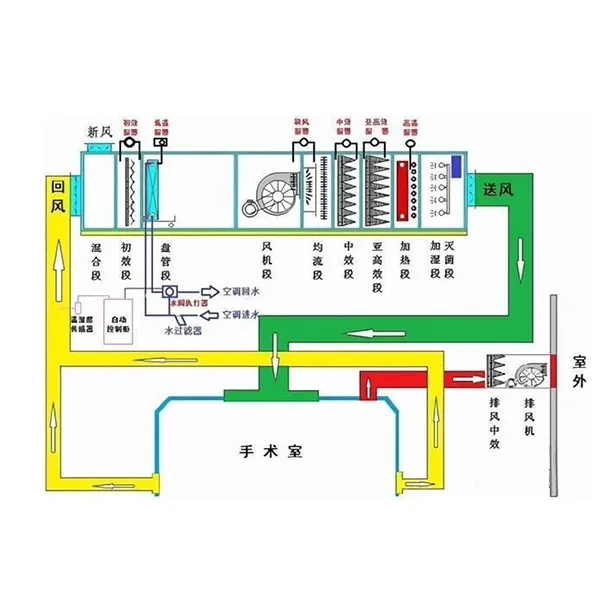
Since the operation of the cleaning system is influenced by many factors, for its effective operation it is necessary not only the main air conditioning units, but also the final devices - high-quality air ducts and valves, as well as an appropriate automatic control system.
Below we look at the important role of ducts and valves in terms of five main factors: cleanliness, air flow, pressure drop, temperature and humidity, duty cycle and general disinfection.
Air dampers
01
Supply air purity and flow
Cleanliness in air-conditioned areas in pharmaceutical plants is generally classified into four classes: A, B, C and D.
Class A corresponds to class 100 (ISO 5) in both static and dynamic mode, and the supply air flow is unidirectional:
Class B corresponds to class 100 (ISO 5) in static mode and class 10,000 (ISO class 7)
Class C: static purity 10,000 (ISO class 7), dynamic purity 100,000 (ISO class 8)
Class D: static cleanliness 100,000 (ISO class 8), dynamic cleanliness not required.
Class A areas should generally be located within Class B areas. The most common options are:
(1) Lamplid cap:
(2) An area consisting of fan filter units (FFU), with a recommended supply air velocity of 0.45 × (1 ± 20%) m/s. For clean areas of classes B, C and D, as a rule, the following requirements for air change frequency n must be met: namely: class B: n = 40–60 times/h
Class C: n = 15–25 times/hour
Class D: n = 10–15 times/hour
However, in practical examples, the air change rate commonly used for classes B, C and D is usually:
Class B: n ≥ 50 times/h;
Class C: n ≥ 25 times/h;
Class D: n ≥ 20 times/hour.
It follows that to achieve the required degree of cleanliness in pharmaceutical cleanrooms, the frequency of air changes is typically more than 20 times per hour, which is significantly higher than the 6-10 times per hour required to eliminate heat and humidity loads in air-conditioned areas.
Of course, from an energy saving point of view, the supply air flow rate in clean rooms should not be increased arbitrarily, as long as the following five maximum values are observed:
(1) Supply air flow required to eliminate the heat and humidity load in the conditioned space:
(2) Supply air flow required to replenish the volume of exhaust air removed by the process equipment:
(3) Supply air flow required to ensure a fresh air standard of 40 m³/h per employee:
(4) Supply air flow required to maintain positive pressure in the clean room:
(5) The supply air flow rate required to ensure the required degree of cleanliness, which is calculated as the product of the volume of the clean room and the number of air changes, and for the number of air changes the lower limit symbol should be used first,
That is, class B: n = 50 times/h
class C: n = 25 times/h
class D: n = 20 times/h
After calculating the supply air flow rate for each clean zone according to the above requirements, it becomes extremely important to ensure the flow rate stability to meet the cleanliness class requirements, and in this process, the stability of the air dampers plays an important role.
02
Pressure drop
During the production of medicinal products, ensuring a certain pressure difference (i.e. static pressure difference) between clean and unclean rooms, as well as between clean rooms of different cleanliness classes, is a prerequisite.
The Pharmaceutical Cleanroom Design Guidelines (GB50457-2008), the Quality Management Guidelines for Pharmaceutical Manufacturing (2010 Revision) and the GMP Guidelines for Drugs: Manufacturing Facilities, Facilities and Equipment provide relevant provisions regarding the above pressure drop.
In projects and engineering examples, taking into account development trends at home and abroad, the above pressure drop is recommended to be set at "not less than 10 Pa", however, in international regulatory authorities or some well-known pharmaceutical companies, the pressure drop of "not less than 12.5 Pa" is often selected for the purification areas of certain drugs (including blood products).
Sometimes it is also necessary to maintain a certain pressure difference between clean rooms of the same cleanliness class, for example 5–10 Pa.
To ensure the specified stable pressure drop, fixed or variable air flow valves, as well as an automatic pressure drop control system, should be used.
The most common two control methods are:
(1) In the cleaning area with a constant supply air flow rate, a remote air flow sensing and control valve is installed to automatically fix the supply air flow rate in the clean room, and a differential pressure control valve is installed on the return or exhaust air piping of the clean room. For large volume cleanrooms, one remote air flow sensing and control valve and multiple differential pressure control valves can be installed, and the opening degree of the above differential pressure control valves can be automatically adjusted according to the required room pressure drop.
(2) In a variable air flow cleaning area, provided that the minimum supply air flow rate in the clean area is maintained at all times, remote sensing and air flow control valves are installed on the clean room supply, return (or exhaust) air ducts. First, the air flow in the supply air duct is regulated in accordance with the technological requirements, and then, depending on the required pressure difference in the room, the degree of opening of the valves for remote measurement and control of air flow in the return and exhaust air ducts is automatically adjusted.
03
Temperature and humidity
Temperature and humidity parameters in pharmaceutical cleanrooms, unless there are special requirements, for classes A, B and C:
In summer t = 20–24 °C, relative humidity (rh) = 50–65%,
In winter t = 18–20 °C, relative humidity (rh) = 45–60%:
Class D: summer t=22~26℃ rh=50%~65%,
In winter t=18~20℃ rh=45%~60%.
Generally, in summer, the air dew point temperature in the above clean rooms is 12~14.5℃, in order to meet the specified temperature and humidity parameters, it is necessary to maintain a constant dew point temperature. Typically, for automatic control, temperature and humidity sensors are installed on the main supply (or exhaust) air pipe or in important rooms, which automatically control the degree of opening of the control valves on the cold and hot water or steam pipes in the air conditioning system. Precise adjustment and stable positioning of control valves can effectively ensure the required temperature and humidity conditions.
04
Duty mode
In high-level medical cleanrooms (typically Classes A, B, and C) where the cleaning system is not operating on a three-shift basis, a standby mode is usually required during the break between shifts. To do this, the drives of the supply and exhaust fans must be equipped with motors with variable frequency drives and frequency converters, which allows the fan rotation speed to be switched to standby mode (for example, from the usual 45 Hz to 35 Hz).
In general, Class A zones are usually located within Class B zones and can be turned on and off according to actual process requirements without requiring standby operation:
In class B zones, the air exchange rate during normal operation is 50–60 times/hour, and during operation in standby mode - 20–25 times/hour:
In class C zones, the air exchange rate during normal operation is 25–30 times/hour, and during standby mode — 10–15 times/hour:
Sometimes standby mode is also required for class D zones. In this case, the frequency of air exchange in class D zones during normal operation is 15–20 times/hour, and during standby mode — 8–12 times/hour.
When setting up the standby operation mode by regulating the flow of supply, return and exhaust air in a clean room, it is also relatively easy to ensure the required pressure drop in the clean room, and the design of rational dampers on the air ducts plays a decisive role.
05
General disinfection
After shutdown and resumption of operation, or after a certain period of operation in pharmaceutical cleanrooms, microorganisms affecting the production environment often create a risk of exceeding the permissible limits of the total number of microorganisms, therefore it is necessary to carry out a major disinfection and switch the air purification and conditioning system to a major disinfection mode. Currently, the most common methods of major disinfection in pharmaceutical cleanrooms are ozone disinfection, hydrogen peroxide (hydrogen peroxide) disinfection, and ultraviolet disinfection.
Among them, ozone disinfection is the most common and widely used. First, the cleaning system is switched to the major disinfection mode (that is, the exhaust system in this cleaning zone is turned off), and then the amount of ozone calculated based on the volume of the clean zone is supplied to the clean zone (clean room) through the supply air ducts of the cleaning system. After reaching the disinfectant concentration, the circulation mode is started, and after the circulation time meets the requirements of major disinfection, the return air intake valve is closed, the disinfectant exhaust fan and the original exhaust fan of the air purification and conditioning system are turned on. Only the supply fans operate until the sanitary conditions in the clean room are met.
The sealed valve, equipped with EPDM rubber gaskets, ensures a virtually complete seal, preventing ozone leakage, and high corrosion resistance guarantees a service life of more than ten years.